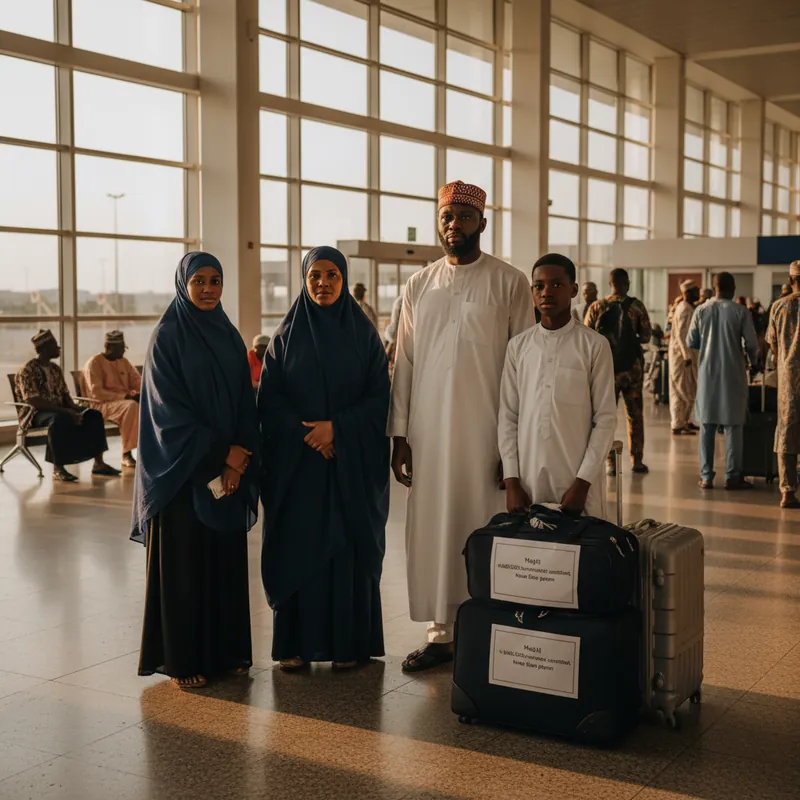
NAHCON Nigerian Hajj: Quota, State Distribution & Pilgrim Timing
Nigeria is one of the largest single sources of Hajj pilgrims in the world, with a Saudi-allocated quota of approximately 95,000 places — second globally only to Indonesia. The National Hajj Commission of Nigeria (NAHCON) coordinates this operation every year across all 36 states plus the Federal Capital Territory. Because the pilgrimage follows the Islamic lunar calendar, it falls roughly eleven days earlier each Gregorian year: the 2026 rites fell in late May and early June, so the next cycle is expected in mid-May 2027 — confirm the exact Dhu al-Hijjah dates with NAHCON and the Saudi Ministry of Hajj rather than treating any single date as fixed. This guide is maintained across cycles: the quota mechanics, the state-board distribution, the realistic cost stack, and the LOS, ABV and KAN flight choices below repeat every year, and the registration windows are written relative to the Hajj year so they stay correct whichever cycle you are planning for. If you are booking now, your first step is your state pilgrim welfare board.
TL;DR: Nigerian Hajj 2026 package cost lands in the $3,500-5,000 (NGN 5.4-7.7 million) range per pilgrim. The flight component is $1,800-2,200 depending on carrier (Air Peace, Saudia, Max Air, EgyptAir via Cairo). NAHCON allocates the 95,000-pilgrim Saudi quota across 36 states + FCT via state pilgrim welfare boards. Registration windows close roughly 120 days before Dhu al-Hijjah 8 (so for a mid-May pilgrimage the state-board window closes around early February of the same year). Hajj is performed once in a Muslim’s lifetime as the 5th pillar of Islam — the practical logistics below are written for that gravity.
In this guide
- NAHCON and the 95,000-slot Saudi quota
- State-by-state quota distribution
- Hajj 2026 timeline from registration to departure
- LOS-JED, ABV-JED and KAN-JED flight comparison
- Total cost breakdown for the 2026 pilgrim
- Three pilgrim case studies
- Frequently asked questions
How is the 95,000-slot Nigerian Hajj quota allocated each year? {#nahcon-quota-explained}
The National Hajj Commission of Nigeria (NAHCON) was established by Act of the National Assembly in 2006 and is the only federal body authorised to organise, coordinate and supervise the Hajj for Nigerian Muslims. It operates under the Office of the Vice President as a parastatal and is the sole counterpart to the Saudi Ministry of Hajj and Umrah for Nigerian pilgrim documentation, visa issuance and quota distribution.
The Saudi quota of approximately 95,000 places is calculated by the Saudi Ministry of Hajj using the historical 1:1,000 Muslim-population formula (one quota place per thousand Muslims in the country). Nigeria’s Muslim population — roughly 53 percent of approximately 220 million — gives the country its 95,000 allocation, second only to Indonesia (approximately 221,000 quota). The figure is reviewed annually; in pandemic years (2020-2021) the global quota was reduced and Nigeria’s share fell proportionally.
NAHCON divides the 95,000 quota into three tracks:
- State pilgrim welfare boards — approximately 87,000 places distributed across the 36 states plus FCT, allocated by state Muslim population and historic uptake
- Private tour operators (PTOs) — approximately 7,000-8,000 places allocated to NAHCON-accredited private operators
- NAHCON-direct reserve — a small holding pool for late assignments, official delegations and exceptional cases
A pilgrim cannot apply directly to NAHCON in most cases — applications flow through the state pilgrim welfare board (e.g. Kano State Pilgrim Welfare Board, Lagos State Muslim Pilgrims Welfare Board) or through an accredited PTO.
The Hajj Savings Scheme (HSS)
NAHCON’s Hajj Savings Scheme, run in partnership with Jaiz Bank and other approved Islamic finance institutions, lets prospective pilgrims accumulate the package cost over multiple years through structured monthly contributions. The scheme is Shariah-compliant (no interest), locks in priority allocation, and partially hedges the NGN-USD volatility that has historically created painful last-minute top-ups. For 2026 pilgrims who began HSS contributions in 2023-2024, the effective cost is materially below the spot-rate package cost paid by late-registering applicants.
How is the NAHCON quota distributed state-by-state each year? {#state-distribution}
The 87,000-place state pilgrim board allocation is not evenly distributed — Northern states with larger Muslim populations receive the lion’s share, with Kano, Sokoto, Katsina and Kaduna routinely topping the table. Lagos and the South-West states (Oyo, Osun, Ogun) also receive substantial allocations reflecting the large Yoruba Muslim population.
Below are the top 10 state quotas based on the most recent published allocation pattern (NAHCON publishes the official split for each Hajj year in the January-February announcement window; the shares below move only marginally year to year):
| Rank | State | Quota (approx.) | Dominant pilgrim community |
|---|---|---|---|
| 1 | Kano | 8,200 | Hausa-Fulani Muslim majority |
| 2 | Sokoto | 5,400 | Hausa-Fulani Muslim majority |
| 3 | Katsina | 5,100 | Hausa-Fulani Muslim majority |
| 4 | Kaduna | 4,900 | Hausa-Fulani + Northern Christian minority |
| 5 | Bauchi | 4,700 | Hausa-Fulani Muslim majority |
| 6 | Lagos | 4,600 | Yoruba Muslim majority + diaspora |
| 7 | Borno | 4,200 | Kanuri + Hausa-Fulani Muslim majority |
| 8 | Jigawa | 4,100 | Hausa-Fulani Muslim majority |
| 9 | Niger | 3,900 | Hausa-Fulani Muslim majority |
| 10 | Yobe | 3,700 | Kanuri + Hausa-Fulani Muslim majority |
The remaining 26 states plus the FCT share approximately 38,200 places. Southern Christian-majority states (Anambra, Imo, Enugu, Abia) receive small allocations (typically 200-400) reflecting their small Muslim populations.
State pilgrim welfare boards manage their own internal allocation rules: most prioritise first-time pilgrims who have completed two or more years of Hajj Savings Scheme contributions, with secondary preference for community-nominated cohorts (mosque groups, professional associations).
The annual Hajj timeline from registration to departure {#hajj-2026-timeline}
The full pilgrim journey runs over approximately 18 months when counted from initial HSS contribution. The compressed final six months — the part most pilgrims experience directly — repeats every cycle, so the table below is written relative to the pilgrimage rather than to a single year’s calendar. The Gregorian months in brackets show where the 2027 cycle (a mid-May Hajj) would fall; shift them earlier by about eleven days for each later year.
| Stage | Timing (relative to the Hajj year) | What the pilgrim does |
|---|---|---|
| NAHCON quota announcement | Q1 of the Hajj year (Jan-Feb) | NAHCON publishes official state quota |
| State board registration close | ~120 days before departure (mid-Feb) | Final HSS top-up + biodata submission |
| Quota draw / final list | ~110 days before (late Feb) | State board publishes selected pilgrims |
| Final package payment | ~90 days before (Mar) | Balance NGN paid to state board account |
| Biometrics + e-passport check | ~75 days before (Mar-Apr) | Capture at state board office or NIS |
| Saudi e-visa via NAHCON | ~45 days before (Apr) | NAHCON batches visa applications via Nusuk |
| Pre-departure orientation | ~30 days before (Apr-May) | State board mandatory orientation sessions |
| Departure flight | Airlift window, ~3 weeks pre-Hajj | Phased airlift from LOS, ABV, KAN, PHC, MMA |
| Hajj rites (Mecca + Mina + Arafat) | Dhu al-Hijjah 8-13 (mid-to-late May in 2027) | The pilgrimage itself |
| Return flight | 1-2 weeks after Eid al-Adha | Phased return airlift |
The total quota is not flown on a single day — it is moved over a roughly 3-week pre-Hajj window in coordinated charter rotations. NAHCON’s airlift plan (the “Hajj Air Operations Plan”) is finalised in the March-April before each pilgrimage and is the most operationally complex piece of the annual operation.
Which LOS / ABV / KAN → JED flight serves Nigerian pilgrims best? {#flight-comparison}
Four carriers handle the bulk of the Nigerian Hajj airlift. Air Peace and Max Air are the Nigerian-flag carriers most active in the charter; Saudia operates both charter rotations and scheduled service; EgyptAir provides a one-stop alternative via Cairo at usually lower cost.
| Carrier | Aircraft | Route | One-way Hajj charter USD | Duration | Baggage allowance |
|---|---|---|---|---|---|
| Air Peace (P4) | Boeing 777-300ER | LOS-JED, ABV-JED direct | $1,800-2,100 | 7h 30m | 2 x 23 kg + Zamzam container |
| Max Air (VM) | Boeing 747-400 | KAN-JED, ABV-JED direct | $1,700-2,000 | 7h 45m | 2 x 23 kg + Zamzam container |
| Saudia (SV) | Boeing 777-300ER | LOS-JED, ABV-JED scheduled + charter | $1,900-2,200 | 7h 20m | 2 x 23 kg + Zamzam container |
| EgyptAir (MS) | Boeing 787-9 | LOS-CAI-JED | $1,400-1,700 | 11-13h (with CAI layover) | 2 x 23 kg |
A few practical observations from prior Hajj cycles:
- Direct vs one-stop: Direct charters from LOS, ABV and KAN are the default for NAHCON-managed cohorts. The EgyptAir CAI-connection is more common for private tour operators (PTOs) optimising for cost.
- KAN as origin matters: For Kano State, Katsina, Jigawa, Bauchi and other northern pilgrims, KAN-JED direct on Max Air avoids the domestic feeder leg to Lagos and saves a full day of journey time. This is the operational reason Kano receives disproportionate charter capacity.
- Aircraft considerations: Max Air’s 747-400s are part of the older Hajj-fleet workhorse pattern; Air Peace’s 777-300ER is newer and offers better cabin pressurisation and noise levels, which matters for elderly pilgrims.
- Return Zamzam logistics: All four carriers handle the official 5-litre Zamzam container as a NAHCON-coordinated separate piece; pilgrims do not need to negotiate this individually.
For full carrier-vs-carrier detail see our LOS to JED Air Peace vs Saudia comparison.
Total cost breakdown for the Nigerian pilgrim {#cost-breakdown}
The full NAHCON 2026 package cost typically lands in the $3,500-5,000 (NGN 5.4-7.7 million) range. The variation is driven mainly by Mina tent category (A, B or C), Mecca-hotel proximity to the Haram, and state-board administrative fees.
| Cost component | USD range | NGN range (current band) | Note |
|---|---|---|---|
| Return flight (charter or scheduled) | $1,800-2,200 | NGN 2.8-3.4 million | Air Peace, Max Air, Saudia, EgyptAir |
| Mecca + Madinah accommodation (10-14 nights) | $1,000-1,400 | NGN 1.5-2.2 million | Category B hotel typically; Category A premium |
| Mina tent assignment + Arafat logistics | $400-600 | NGN 620k-930k | Saudi Ministry of Hajj fee component |
| Saudi Hajj visa + Nusuk fee | $150-200 | NGN 230k-310k | Per Saudi tariff |
| NAHCON administrative + state board fee | $100-200 | NGN 155k-310k | State board levy |
| Ground transport (Jeddah-Mecca-Madinah-Mina) | $50-100 | NGN 78k-155k | NAHCON-coordinated buses |
| Local pre-departure expenses (uniform, ihram, vaccines) | $80-150 | NGN 124k-232k | Yellow fever cert + meningococcal vaccine |
| Total | $3,580-4,850 | NGN 5.5-7.5 million | Excludes personal shopping in Saudi |
The official figures NAHCON publishes typically include the first six line items as the “package fee” with the last item (pre-departure prep) paid separately by the pilgrim.
For pilgrims who began Hajj Savings Scheme contributions in 2022 or earlier, the locked-in NGN payments can be materially lower in USD-equivalent terms because the contributions hedged the period of NGN depreciation. Many 2026 pilgrims will have paid effectively $2,800-3,400 over the multi-year accumulation.
Three pilgrim case studies {#case-studies}
Case 1 — Mr Abubakar Ibrahim, Kano (Sabon Gari area), 52, wholesale textile trader
Abubakar has been contributing to the NAHCON Hajj Savings Scheme via Jaiz Bank since 2022. His wife performed Hajj in 2018 with her sisters; this is his first time. Through the Kano State Pilgrim Welfare Board he secured a 2026 quota place in the late-February draw. His total cost works out to approximately NGN 5.6 million ($3,650) for a Category B package — Mecca hotel roughly 700 metres from the Masjid al-Haram, Mina tent Category B, KAN-JED direct on Max Air. He travels with a mosque cohort of 14 pilgrims from his neighbourhood, which makes the Mina tent assignment easier to coordinate. Departure: mid-May (2026 cycle example).
Case 2 — Hajiya Maryam Aliyu, Lagos (Surulere), 41, secondary school teacher
Hajiya Maryam applied through the Lagos State Muslim Pilgrims Welfare Board (LSMPWB). Lagos quota is substantially smaller than Kano in absolute terms (4,600 vs 8,200) but the applicant pool is also smaller; she was selected on her second application year. Her package is Category C — slightly further hotel from the Haram, Mina tent Category C — at NGN 5.2 million ($3,400). She travels alone in the LSMPWB-organised women’s cohort (Saudi Ministry of Hajj policy permits women 18+ to perform Hajj within an organised group without an individual Mahram). Departure: LOS-JED direct on Air Peace, mid-to-late May.
Case 3 — Sheikh Suleiman Bello, Sokoto, 68, Islamic scholar and community imam
Sheikh Suleiman is performing his second Hajj (first was in 1998). His state board, Sokoto State Pilgrim Welfare Board, allocates him a Category A premium package at NGN 7.4 million ($4,800) reflecting his community standing and the larger Sokoto quota. He travels via ABV-JED on the Saudia scheduled rotation alongside the Sokoto delegation, with his cousin (also a Hajj veteran) accompanying him for the post-Hajj Madinah leg. Pre-departure orientation: Sokoto, 28 April 2026. Flight departure: mid-May.
If a Hajj flight is delayed or cancelled
The NAHCON airlift moves most pilgrims on dedicated Hajj charter rotations (Air Peace, Max Air, Saudia charter). A dedicated charter is contracted between the state pilgrim welfare board or accredited operator and the carrier, so the pilgrim’s contract of carriage sits with the Hajj framework and the operator — not directly with the airline. Because of that, EU261-style fixed compensation, Saudi GACA scheduled-flight remedies and automated claim services such as AirHelp do not apply to a dedicated Hajj charter; a delayed-airlift grievance is raised first with NAHCON and your state board. The one exception is a genuinely scheduled IATA sector — for example a scheduled Saudia LOS-JED ticket bought outside the charter, or an EgyptAir scheduled connection via Cairo — where GACA passenger-protection rules do apply. Keep your boarding pass and the operator’s grievance contact either way.
Frequently asked questions {#faq}
1. What is the NAHCON Hajj Savings Scheme (HSS)? The Hajj Savings Scheme is a multi-year deposit programme administered by NAHCON in partnership with Jaiz Bank and other approved Islamic finance institutions. Pilgrims contribute monthly toward the full Hajj package cost (approximately NGN 5.6 million for 2026), locking in foreign-exchange rates and securing priority quota allocation through their state pilgrim welfare board.
2. Do Nigerian women pilgrims still require a Mahram for Hajj 2026? Saudi Ministry of Hajj policy since 2021 permits women aged 18 and above to perform Hajj without a Mahram provided they travel within an organised group registered through NAHCON or an accredited state pilgrim board. The group itself functions as the supervisory unit. Independent solo Hajj is not currently permitted for Nigerian pilgrims under the NAHCON-managed quota.
3. What are the official NAHCON Zamzam and baggage rules for return to Nigeria? Each NAHCON-registered pilgrim is entitled to one 5-litre Zamzam container provided through the official NAHCON return-baggage channel, plus a standard checked allowance of two pieces totalling 46 kg on Hajj charter carriers (Air Peace, Max Air, Saudia). Excess gifts beyond personal allowance are typically routed via separate cargo at the pilgrim’s cost.
4. Can I book my own LOS-JED flight and join Hajj independently? No. The Saudi Hajj visa is issued exclusively through the NAHCON-managed quota and accredited tour operators for Nigerian pilgrims. A scheduled Saudia or Air Peace ticket purchased independently outside the NAHCON channel will not be accepted at the Saudi border for Hajj purposes. Independent travel during the Hajj season requires Umrah visa documentation, which is distinct.
5. What is the refund policy if a pilgrim cannot travel after final payment? NAHCON and state pilgrim welfare boards typically refund 80-90 percent of the deposited package amount minus already-committed costs (visa fee, accommodation deposit, charter seat commitment) if the cancellation is registered before the quota draw is finalised. Post-draw cancellations recover a smaller portion. Each state board publishes its own schedule; Kano State Pilgrim Welfare Board (KSPWB) and Lagos State Muslim Pilgrims Welfare Board (LSMPWB) typically post the schedule in February-March of the Hajj year.
Planning your Hajj journey
The Nigerian Hajj operation is one of the most logistically sophisticated annual movements of people in West Africa. NAHCON and the 37 state-level pilgrim welfare boards have refined the airlift over decades, and the structure — quota allocation through state boards, accredited carriers on the charter rotation, Saudi e-visa via Nusuk — exists precisely to make the journey safer and more predictable for first-time pilgrims.
If you are still in the planning stages, the Hajj quota tracker for NAHCON, SAHUC, KAHCON and GHC gives you the official allocation figures across all four major African Hajj bodies. For the carrier-by-carrier comparison on the Lagos route specifically, see our LOS to JED Air Peace vs Saudia breakdown. For pilgrims in other African countries, our parallel guides cover the South African Cape Malay community via SAHUC, the Mombasa pilgrim cohort via KAHCON, and the Accra pilgrim track via GHC.
For live LOS-JED fare tracking and Air Peace charter slot availability, see our Lagos to Jeddah flights page and the dedicated Air Peace airline guide or Saudia airline guide.
Sources
- NAHCON — National Hajj Commission of Nigeria
- Saudi Ministry of Hajj & Umrah — Annual Quota Communique
- Nigerian Civil Aviation Authority — Charter Oversight
- GACA — Saudi Aviation Authority Regulations
- IATA — Hajj Operations Bulletin
Last verified: 2026-06-22