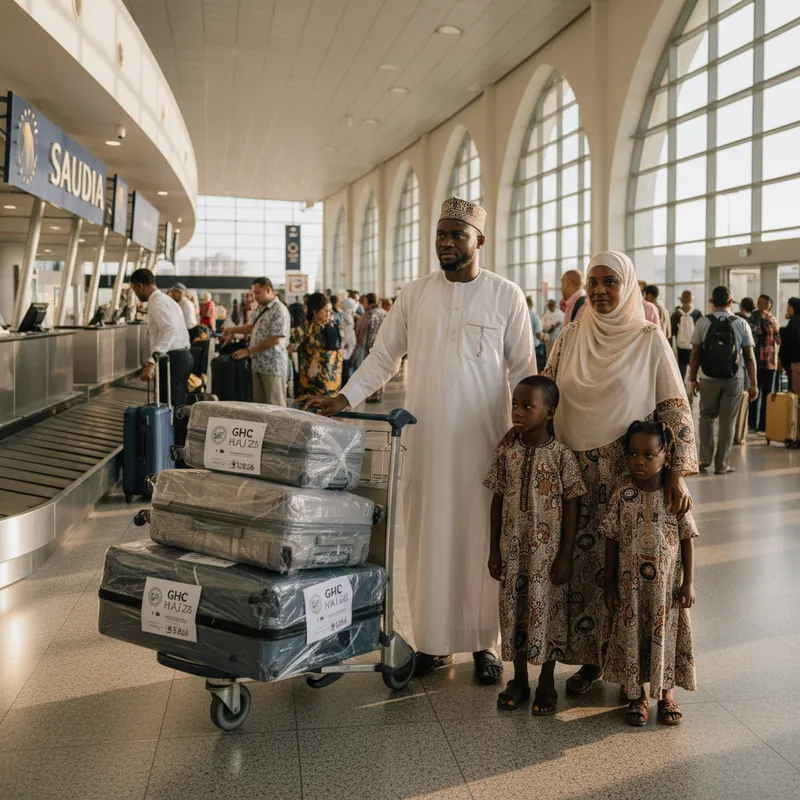
GHC Ghana Hajj: Accra Pilgrim Quota, ACC → JED Direct or via LOS
Ghana’s Muslim population — approximately 20 percent of the national population of roughly 34 million, or about 6.8 million people — is concentrated heavily in the five Northern regions: Northern, Savannah, North East, Upper East and Upper West. The Hausa, Dagomba, Mamprusi, Gonja and Wala Muslim communities of these regions form the historical core of Ghanaian Islam, with significant urban Muslim communities also present in Accra (particularly the Madina, Nima and Mamobi zongo neighbourhoods) and in Kumasi. The Ghana Hajj Committee (GHC) administers the Saudi-allocated Hajj quota of approximately 6,200 places annually. This guide is maintained across cycles and unpacks the GHC quota structure, the Northern Ghana Muslim communities, the ACC-JED flight options, and the realistic cost breakdown. The Hajj moves about eleven days earlier each Gregorian year (the 2026 rites fell in late May, the next cycle is expected mid-May 2027); registration runs through the regional Pilgrim Affairs Offices ahead of each pilgrimage, so the mechanics below apply whichever cycle you are planning for.
TL;DR: Ghana Hajj 2026 package cost lands in the $2,800-4,200 (GHS 36,000-55,000) range per pilgrim. The flight component is approximately $1,000-1,400 (GHS 13,000-18,000) on ACC-JED direct via Saudia, or ACC-LOS-JED via Air Peace, or ACC-CAI-JED via EgyptAir. GHC administers the 6,200-place Saudi quota through accredited operators and regional Pilgrim Affairs Offices (PAOs) in Northern Ghana plus Greater Accra. The Hausa, Dagomba, Mamprusi, Gonja and Wala Muslim communities of Northern Ghana form the historical core of the GHC pilgrim cohort. Hajj is the 5th pillar of Islam — the structure here exists to make the journey safe and predictable for the first-time pilgrim.
In this guide
- GHC and the 6,200-place Saudi quota
- Northern Ghana Muslim communities
- ACC-JED, ACC-LOS-JED, ACC-CAI-JED flight options
- Saudia Ghana Hajj charter product
- Total cost breakdown $2,800-4,200
- Three pilgrim case studies
- Frequently asked questions
How is the 6,200-place Ghana Hajj quota allocated each year? {#ghc-quota}
The Ghana Hajj Committee (GHC) is the body recognised by the Saudi Ministry of Hajj and Umrah as the official counterpart for Hajj visa allocation for Ghanaian pilgrims. GHC was established to coordinate the Ghanaian Muslim community’s annual pilgrimage and works in conjunction with state-level Pilgrim Affairs Offices (PAOs) located in the Muslim-majority regions of Northern Ghana plus Greater Accra and Ashanti.
The Saudi quota of approximately 6,200 places (reviewed for each Hajj year) is calculated using the standard Saudi Ministry of Hajj 1:1,000 Muslim-population formula. Ghana’s Muslim population — approximately 20 percent of the country’s 34 million people — yields the 6,200 quota allocation. The figure is reviewed annually.
GHC distributes the 6,200 quota across the regional PAOs and accredited operators, with the regional split broadly reflecting Muslim-population distribution:
- Northern Region (Tamale and environs) — approximately 18-20 percent of allocation
- Greater Accra (Accra Madina, Nima, Mamobi, Sabon Zongo) — approximately 15-18 percent
- Upper East Region (Bolgatanga) — approximately 10-12 percent
- Upper West Region (Wa) — approximately 9-11 percent
- Savannah and North East Regions — approximately 10-12 percent combined
- Ashanti Region (Kumasi) — approximately 12-14 percent
- Other regions — the remainder (Central, Volta, Brong-Ahafo, Western)
A Ghanaian pilgrim applies through the regional Pilgrim Affairs Office or a GHC-accredited operator. The PAO or operator submits documentation to GHC for visa batching to the Saudi Ministry of Hajj via the Nusuk platform.
The role of state-level PAOs
The Pilgrim Affairs Office is the practical local interface for the Hajj application process. PAOs handle regional pilgrim registration, biometrics capture, pre-departure orientation sessions (typically held in the April-May before departure), and ground transport from the regional capital to Accra Kotoka International Airport (ACC) for the Hajj airlift. The Tamale, Wa and Bolgatanga PAOs are the largest operationally given their proximity to the most concentrated Muslim populations.
Northern Ghana Muslim communities {#northern-ghana-communities}
Ghana’s Muslim heritage in the Northern regions is anchored in five principal ethnic communities, each with distinct linguistic and cultural traditions but unified within the GHC Hajj framework.
Hausa
Hausa Muslims in Ghana are descendants of trade-route migrants from what is now Northern Nigeria and Niger, with continuous Ghanaian presence dating to the 15th-17th century trans-Saharan trade era. Hausa communities are concentrated in the zongo neighbourhoods of major cities — Accra Madina, Accra Sabon Zongo, Kumasi Aboabo and Asawasi — where Hausa serves as a lingua franca for inter-ethnic Muslim community life. Hausa scholarship traditions, including the wider Sokoto-Caliphate intellectual heritage, remain influential in Ghanaian Islamic education.
Dagomba
The Dagomba ethnic community of the Northern Region, centred on Tamale and the Yendi traditional area, is one of Ghana’s largest Muslim-majority ethnic groups. Dagbani-language Islamic instruction is well-established, and the Dagomba Hajj cohort is typically organised through the Tamale PAO with multi-family group bookings drawn from extended family and clan networks.
Mamprusi, Gonja and Wala
The Mamprusi (Nalerigu, Gambaga area), Gonja (West and East Gonja, including the historic Salaga trading centre) and Wala (Wa and Upper West Region) ethnic communities each have substantial Muslim populations with their own linguistic and historical traditions. The Wala Muslim community of Wa town is particularly known for the historic Wa Naa palace mosque tradition and ongoing Quranic scholarship.
Asante and other Akan Muslim communities
Asante Muslim communities in Kumasi and the wider Ashanti Region, alongside Muslim communities in other Akan-speaking areas, form a fourth substantial strand of Ghanaian Islam. The Kumasi zongo neighbourhoods of Aboabo and Asawasi are major urban Muslim centres.
Which ACC → JED flight options serve Ghanaian pilgrims? {#flight-options}
| Routing | Carrier | Aircraft | One-way USD (typical) | Duration |
|---|---|---|---|---|
| ACC-JED direct | Saudia (SV) | Boeing 777-300ER | $900-1,200 | 7h 30m |
| ACC-LOS-JED | Air Peace (P4) | 737 + 777-300ER | $850-1,100 | 9-11h with LOS connection |
| ACC-CAI-JED | EgyptAir (MS) | A320 + 787-9 | $700-950 | 10-13h with CAI layover |
| ACC-ADD-JED | Ethiopian (ET) | 737 + 787 | $700-900 | 10-12h with ADD layover |
| ACC-DXB-JED | Emirates (EK) | 777 + 777 | $800-1,000 | 13-16h with DXB layover |
Key observations:
- Saudia ACC-JED direct is the most efficient routing and is the default for many GHC-accredited operators serving the Greater Accra and Ashanti cohorts. Saudia supplements its scheduled service with charter rotations during the Hajj airlift window.
- Air Peace ACC-LOS-JED is used by GHC-accredited operators whose Hajj package is bundled with the Nigerian airlift via the Air Peace charter fleet — a cost-efficient option that takes advantage of the larger NAHCON-Air Peace 777 capacity out of Lagos.
- EgyptAir ACC-CAI-JED is the lowest-cost option for many shoulder dates, with EgyptAir’s Boeing 787-9 on the CAI-JED leg providing a modern cabin product. The CAI layover is typically 2-4 hours.
- Ethiopian ACC-ADD-JED offers comparable pricing to EgyptAir with the Ethiopian 787 Dreamliner on the ADD-JED leg.
- Northern Ghana origin pilgrims are bussed by their regional PAO from Tamale, Wa or Bolgatanga to Accra Kotoka International Airport for the airlift. Some PAOs negotiate group charter buses with rest stops at major mosques along the Accra route.
Saudia Ghana Hajj charter product {#saudia-product}
Saudia (SV) is typically the largest single carrier for the GHC Hajj airlift, deploying its Boeing 777-300ER on supplementary direct charter rotations from Accra in addition to its scheduled service.
Cabin and seat
The Saudia 777-300ER for the GHC Hajj rotation operates in a 3-4-3 economy layout with 32-33 inch seat pitch. The aircraft is Sky Interior-equipped, and on certain rotations a small business-class section is preserved for senior delegation pilgrims.
Meal and prayer service
Saudia serves a halal meal — chicken or lamb biryani with date sides — on the ACC-JED rotation. Qibla direction is displayed continuously on the seat-back monitor, and the rear galley is configured as a dedicated prayer space throughout the flight. Saudia is alcohol-free company-wide, in line with Saudi national-carrier policy.
Baggage and Zamzam
Saudia honours the GHC-standard 46 kg checked allowance (two pieces) plus the official 5-litre Zamzam container handled through the return-rotation cargo coordination.
Seat rate
The Saudia ACC-JED Hajj direct charter seat rate is approximately $1,050 per pilgrim ($900-1,200 range, GHS 13,500-15,500). For a return charter seat the figure is approximately $1,800-2,100 (GHS 23,000-27,000) including Zamzam handling.
How much does Ghana Hajj cost, end-to-end? {#cost-breakdown}
| Cost component | USD range | GHS range (current band) |
|---|---|---|
| Return flight (Saudia direct or Air Peace via LOS) | $1,800-2,100 | GHS 23,000-27,000 |
| Mecca accommodation (10-14 nights) | $400-800 | GHS 5,100-10,300 |
| Madinah accommodation (4-7 nights) | $250-450 | GHS 3,200-5,800 |
| Mina tent + Arafat logistics | $300-500 | GHS 3,900-6,400 |
| Saudi Hajj visa + Nusuk fee | $150-200 | GHS 1,900-2,600 |
| GHC + PAO administrative fee | $150-300 | GHS 1,900-3,900 |
| Ground transport (Jeddah-Mecca-Madinah-Mina + regional Ghana feeder) | $100-200 | GHS 1,300-2,600 |
| Pre-departure (ihram, vaccines) | $80-150 | GHS 1,000-1,900 |
| Total | $3,230-4,700 | GHS 41,300-60,500 |
| Economy category low end | $2,800 | GHS 36,000 |
The lower end of the range ($2,800-3,200) corresponds to GHC-accredited operators offering Economy category packages with ACC-CAI-JED routing on EgyptAir, Mecca hotel 1,000-1,500 metres from the Masjid al-Haram, and Mina Category C tent. The upper end ($3,800-4,200) corresponds to Standard packages with Saudia direct and closer Mecca proximity.
Three pilgrim case studies {#case-studies}
Case 1 — Mallam Yakubu Mahama, Tamale (Northern Region), 55, Dagomba secondary school teacher
Mallam Yakubu is a first-time pilgrim from Tamale, applying through the Northern Region Pilgrim Affairs Office. He is travelling with his wife as part of a Tamale cohort of 38 pilgrims, organised by a GHC-accredited operator with a long history serving the Dagomba community. Their package is Standard category — Mecca hotel approximately 700 metres from the Masjid al-Haram, Mina Category B tent — at GHS 47,000 ($3,650) per pilgrim. Routing: regional feeder bus from Tamale to Accra, then ACC-JED direct on Saudia 777-300ER. Departure from ACC: mid-May (2026-cycle example).
Case 2 — Alhaji Ibrahim Abdulai, Accra (Madina), 47, wholesale textiles trader
Alhaji Ibrahim is travelling with his elderly father (aged 73) and an adult son under a GHC-accredited Accra-based operator serving the Madina and Nima zongo communities. Their package is Premium category — Mecca hotel approximately 350 metres from the Haram, Mina Category A tent — at GHS 53,000 ($4,100) per pilgrim, reflecting the elderly-pilgrim preference for close proximity. Routing: ACC-JED direct on Saudia 777-300ER. The Madina operator’s cohort of 32 pilgrims is drawn primarily from the Hausa and Yoruba zongo communities of central Accra. Departure: mid-May.
Case 3 — Hajiya Hawa Suleiman, Wa (Upper West Region), 49, Wala community health worker and madrasa teacher
Hajiya Hawa is a first-time pilgrim from Wa, applying through the Upper West Pilgrim Affairs Office. She travels as part of the Wa women’s cohort under the Saudi Ministry of Hajj policy permitting women 18+ in organised groups without an individual Mahram. Her package is Standard category at GHS 42,000 ($3,250), with Mecca hotel approximately 850 metres from the Haram and Mina Category B tent. Routing: regional feeder bus from Wa to Accra (overnight via Tamale), then ACC-CAI-JED on EgyptAir for cost efficiency. The Wa cohort of 22 women pilgrims is escorted by the Upper West PAO liaison officer through the airlift. Departure from ACC: mid-to-late May.
If a Hajj flight is delayed or cancelled
Most Ghanaian pilgrims fly on dedicated Hajj-charter rotations (Saudia charter, or Air Peace bundled via Lagos), with some on scheduled EgyptAir or Ethiopian connections. The distinction matters if a flight is disrupted. A dedicated Hajj charter is contracted between the GHC-accredited operator and the carrier, so the pilgrim’s contract of carriage sits with the operator and the Hajj framework — EU261-style fixed compensation, Saudi GACA scheduled-flight remedies and automated claim services such as AirHelp do not apply, and a grievance is raised first with the operator and GHC. On a genuinely scheduled ticket (an EgyptAir CAI connection, say), the operating carrier’s national passenger-protection rules apply. Keep your boarding pass and the operator’s contact either way.
Frequently asked questions {#faq}
1. What is GHC and how does it administer the Ghana Hajj quota? The Ghana Hajj Committee (GHC) is the body recognised by the Saudi Ministry of Hajj and Umrah as the official counterpart for Hajj visa allocation for Ghanaian pilgrims. GHC works in conjunction with state-level Pilgrim Affairs Offices (PAOs) in the Northern, Upper East, Upper West and other Muslim-population regions, plus the Greater Accra Pilgrim Affairs Office, to distribute the Saudi-allocated quota of approximately 6,200 places annually through accredited operators and regional cohorts.
2. Are there direct flights from Accra to Jeddah for the GHC Hajj 2026 airlift? Saudia (SV) operates supplementary direct ACC-JED charter rotations during the GHC Hajj 2026 airlift window in May-June 2026 alongside its scheduled service. Air Peace operates ACC-LOS-JED routings via Lagos for cohorts whose package is bundled through the Nigerian charter fleet, and EgyptAir (MS) operates ACC-CAI-JED via Cairo as a third option. The choice is set by the GHC-accredited operator and the cohort group rather than by the individual pilgrim.
3. Do Ghanaian women pilgrims require a Mahram for Hajj 2026? Saudi Ministry of Hajj policy since 2021 permits women aged 18 and above to perform Hajj without an individual Mahram provided they travel within an organised group registered through GHC or a GHC-accredited operator. The group itself functions as the supervisory unit. Independent solo Hajj is not currently permitted under the Ghanaian quota framework.
4. What is the official GHC Zamzam allowance on the JED return rotation? Each GHC-registered pilgrim is entitled to one official 5-litre Zamzam container handled through the GHC-coordinated return cargo channel on Saudia, Air Peace and EgyptAir Hajj rotations. This is in addition to the standard two-piece checked allowance totalling 46 kg per pilgrim. The Zamzam handling is arranged by the GHC-accredited operator and is not negotiated individually by the pilgrim.
5. What is the role of state-level Pilgrim Affairs Offices (PAOs) in the Ghana Hajj system? State-level Pilgrim Affairs Offices (PAOs) operate in the Muslim-majority regions of Northern Ghana (Northern, Upper East, Upper West, Savannah, North East) plus Greater Accra and Ashanti. They handle regional pilgrim registration, biometrics, pre-departure orientation and ground transport to Accra Kotoka International Airport for the Hajj airlift. The PAOs report to GHC and operate as the practical local interface for the Hajj application process.
Planning your GHC Hajj journey
Ghana’s Hajj operation, anchored by the GHC and the regional Pilgrim Affairs Offices in Northern Ghana plus Greater Accra and Ashanti, is one of the more geographically distributed pilgrim systems in West Africa. The procedural path from regional PAO registration through Accra airlift to Jeddah is well-established, with multiple flight routing options that suit different cost preferences and cohort group structures.
For the broader African Hajj context, see our parallel pillars on NAHCON Nigerian Hajj 2026, the SAHUC South African Hajj Cape Malay community, and the KAHCON Kenya Hajj 2026 Mombasa pilgrim guide. For the year-round Umrah alternative, see our Umrah year-round for African Muslims guide. The cross-country Hajj quota tracker gives the comparative allocations across NAHCON, SAHUC, KAHCON and GHC.
For live fare tracking, see our Accra to Jeddah flights page, the dedicated Saudia airline guide or Air Peace airline guide, and the Accra ACC airport guide.
Sources
- Ghana Hajj Board / Office of the National Chief Imam
- Saudi Ministry of Hajj & Umrah — Annual Quota Communique
- GACA — Saudi Aviation Authority Regulations
- Ghana Civil Aviation Authority — Charter Oversight
- IATA — Hajj Operations Bulletin
Last verified: 2026-06-22