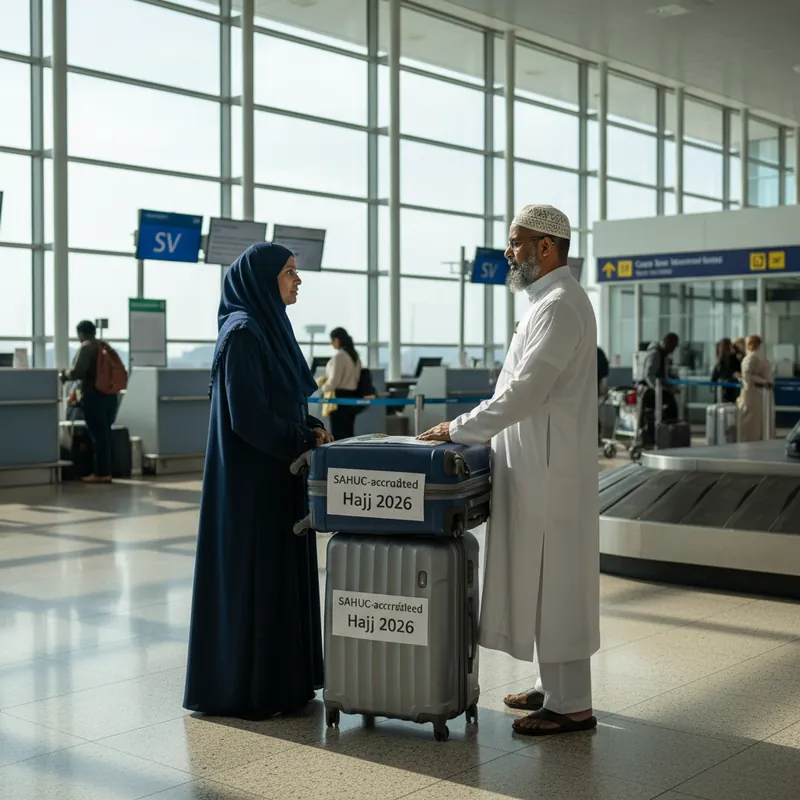
SAHUC SA Hajj: Cape Malay Pilgrim Quota & Logistics
South Africa’s Hajj operation is materially smaller than Nigeria’s in absolute pilgrim numbers but unusually deep in heritage. The South African Hajj and Umrah Council (SAHUC) administers a Saudi-allocated quota of approximately 3,200 places (the allocation is negotiated for each Hajj year and has ranged roughly 2,500-3,200 across recent cycles), with the Cape Malay community of the Western Cape — descended from 17th and 18th century Muslims brought to the Cape from the Indonesian archipelago and South India — forming the historical core of South African Islam. This guide is maintained across cycles and walks through the SAHUC quota structure, the CPT and JNB to Jeddah flight options, the SAHUC-accredited operator panel, and the realistic cost breakdown for the South African pilgrim. Because the Hajj follows the lunar calendar it moves about eleven days earlier each Gregorian year — the 2026 rites fell in late May, the next cycle is expected mid-May 2027 — and SAHUC registration opens August-October of the preceding year, so the window for the coming cycle is imminent as this is updated.
TL;DR: South African Hajj 2026 package cost lands in the $3,800-5,500 (ZAR 70,000-100,000) range per pilgrim. The flight component is approximately $1,400-1,800 (ZAR 26,000-33,000) on CPT-JED via Emirates DXB-connection or JNB-JED direct on Saudia. SAHUC administers the 3,200-place Saudi quota through approximately 60 accredited operators. The Cape Malay Muslim community of the Western Cape, with a continuous 350-year presence dating to 1652-1830, forms the historical core of the South African Hajj cohort. Hajj is the 5th pillar of Islam — the structure described here exists to make the journey safe and predictable for the first-time pilgrim.
In this guide
- SAHUC and the 3,200-place Saudi quota
- Cape Malay community: 350 years of South African Islam
- CPT and JNB to JED flight options
- SAHUC-accredited operators and the package structure
- Total cost breakdown $3,800-5,500
- Three pilgrim case studies
- Frequently asked questions
How is the SA Hajj quota allocated by SAHUC each year? {#sahuc-quota}
The South African Hajj and Umrah Council (SAHUC) is the sole body recognised by the Saudi Ministry of Hajj and Umrah as the official counterpart for Hajj visa allocation for South African pilgrims. It was established to coordinate the South African Muslim community’s annual pilgrimage, working with the South African government on travel documentation and with the Saudi authorities on quota negotiation.
The Saudi quota of approximately 3,200 places is calculated using the Saudi Ministry of Hajj’s 1:1,000 Muslim-population formula. South Africa’s Muslim population — estimated at approximately 1.5 to 1.7 percent of the national population of roughly 60 million, or about 900,000-1 million Muslims — yields the 3,200 quota allocation. The figure is reviewed annually and was reduced in the pandemic years (2020-2021) before reverting to standard levels per the Saudi Ministry of Hajj and Umrah (MoHU).
SAHUC distributes the 3,200 quota through approximately 60 accredited operators across the country, with the largest concentrations of allocation in the Western Cape (reflecting the Cape Malay community), Gauteng (Johannesburg-Pretoria Muslim community, including a substantial Indian-South African Muslim population), and KwaZulu-Natal (Durban Indian Muslim community). Smaller allocations cover the Eastern Cape, Free State and other provinces.
A South African pilgrim cannot apply directly to SAHUC — applications flow through a SAHUC-accredited operator. The operator submits the pilgrim’s documentation to SAHUC, which in turn batches the visa applications to the Saudi Ministry of Hajj via the Nusuk pilgrim platform.
SAHUC pricing oversight
A distinctive feature of the SAHUC system is the published per-package price band. Each year SAHUC publishes a price ceiling for operator packages by category (typically three tiers covering Mecca hotel distance from the Masjid al-Haram and Mina tent category). Operators cannot exceed the SAHUC-published ceiling without justification, which provides a measure of consumer protection for first-time pilgrims.
Cape Malay community: 350 years of South African Islam {#cape-malay-heritage}
The Cape Malay community of the Western Cape, concentrated historically in the Bo-Kaap neighbourhood of Cape Town and across the Cape Flats (Athlone, Bonteheuwel, Mitchells Plain), traces its origins to the period 1652-1830 when the Dutch East India Company brought Muslims from the Indonesian archipelago (Java, Sulawesi, Banten) and South India to the Cape as indentured labourers, political exiles and skilled craftsmen. Notable early figures include Sheikh Yusuf of Makassar, exiled to the Cape in 1694 and considered a founding figure of South African Islam, and Tuan Guru (Imam Abdullah ibn Qadi Abd al-Salam), who in 1794 founded the Auwal Mosque in Bo-Kaap — the oldest mosque in South Africa.
The continuous 350-year presence of the Cape Malay community has produced distinct South African Muslim cultural traditions: the bilingual use of Cape Dutch / Afrikaans alongside Arabic in religious instruction, the development of Afrikaans-Arabic script (Arabic Afrikaans) in the 19th century for early Quranic teaching texts, and a deep tradition of Hajj as a multi-generational community milestone.
The Cape Malay community continues to form the historical centre of the Western Cape SAHUC allocation each cycle. SAHUC-accredited operators based in Bo-Kaap, Athlone and Mitchells Plain typically organise community cohorts around mosque membership, with multi-family group bookings being the norm rather than individual applications.
The Gauteng SAHUC allocation, by contrast, draws more heavily from the South African Indian Muslim community — descendants of Gujarati and Memon Muslims who migrated to South Africa primarily in the late 19th and early 20th centuries, with concentrations in Johannesburg’s Mayfair, Lenasia, Fordsburg, and in Pretoria’s Laudium. Both communities have distinct Hajj traditions but operate under the same SAHUC quota framework.
Which CPT and JNB → JED flights serve Cape Malay pilgrims? {#flight-options}
South African Hajj 2026 pilgrims fly via three primary routings:
| Routing | Carrier | Aircraft | One-way USD (typical) | Duration |
|---|---|---|---|---|
| JNB-JED direct | Saudia (SV) | Boeing 777-300ER | $700-900 | 9h 15m |
| JNB-DXB-JED | Emirates (EK) | A380 + 777 | $650-850 | 11-13h with DXB layover |
| CPT-DXB-JED | Emirates (EK) | A380 + 777 | $750-950 | 14-16h with DXB layover |
| CPT-JNB-JED | SAA + Saudia | A330 + 777 | $700-900 | 13-15h with JNB connection |
A few practical observations:
- Saudia JNB-JED direct is the most efficient routing for Gauteng pilgrims, with daily scheduled service that is supplemented during the Hajj rotation window. The flight time of approximately 9 hours 15 minutes is comparable to other African long-haul routings to the Gulf.
- Emirates via DXB is the most common Cape Town routing. The DXB layover is typically 90 minutes to 3 hours, and Emirates’ DXB facility is well-equipped for Hajj-cohort handling with dedicated Hajj-rotation gates. The Emirates A380 cabin product (3-4-3 economy on A380 long-haul) is consistently rated highly by Cape pilgrim cohorts.
- SAA (South African Airways) JNB-JED has been irregular through the airline’s recent restructuring period; SAHUC-accredited operators have typically defaulted to Saudia or Emirates for Hajj rotations in 2024-2026.
- Cape Town direct to Jeddah is not a scheduled service. Supplementary charter rotations from CPT direct have been considered in past years but are not part of the standard 2026 SAHUC operator panel.
Which SAHUC-accredited operators serve Cape Malay pilgrims? {#accredited-operators}
There are approximately 60 SAHUC-accredited Hajj operators across South Africa, listed and re-approved annually on the SAHUC operator panel. They are categorised by quota allocation size and geographic base. Cape Town-based operators predominantly serve the Cape Malay community; Johannesburg-based operators serve the Gauteng Indian Muslim and broader Muslim community; Durban-based operators serve the KwaZulu-Natal cohort.
Operator packages bundle the following components:
- Return flight (typically Saudia JNB-JED or Emirates JNB/CPT-DXB-JED)
- Mecca accommodation (10-14 nights)
- Madinah accommodation (4-7 nights)
- Mina tent assignment (Category A, B or C)
- Arafat day logistics
- Ground transport (Jeddah-Mecca-Madinah-Mina)
- SAHUC administrative fee
- Saudi Hajj visa coordination
Operators typically offer three package categories — Premium (Mecca hotel within 300 metres of the Haram, Mina Category A tent, business-class flight option), Standard (500-800 metre hotel, Category B tent, economy flight), and Economy (800m+ hotel, Category C tent, economy flight with possible connection).
Total cost breakdown $3,800-5,500 {#cost-breakdown}
The full SAHUC Hajj package lands in the $3,800-5,500 (ZAR 70,000-100,000) range per pilgrim:
| Cost component | USD range | ZAR range (current band) |
|---|---|---|
| Return flight (Saudia direct or Emirates via DXB) | $1,400-1,800 | ZAR 26,000-33,000 |
| Mecca accommodation (10-14 nights) | $700-1,200 | ZAR 13,000-22,000 |
| Madinah accommodation (4-7 nights) | $400-700 | ZAR 7,500-13,000 |
| Mina tent + Arafat logistics | $400-600 | ZAR 7,500-11,000 |
| Saudi Hajj visa + Nusuk fee | $150-200 | ZAR 2,800-3,700 |
| SAHUC administrative + operator fee | $200-400 | ZAR 3,700-7,400 |
| Ground transport (Jeddah-Mecca-Madinah-Mina) | $100-150 | ZAR 1,800-2,800 |
| Pre-departure (ihram, vaccines) | $100-150 | ZAR 1,800-2,800 |
| Total | $3,450-5,200 | ZAR 64,000-95,000 |
| Premium category top-up | +$300-500 | +ZAR 5,500-9,000 |
The Premium category top-up reflects the closer Mecca hotel proximity to the Masjid al-Haram and the Mina Category A tent allocation, both of which are popular with elderly pilgrims and with multi-generational family bookings.
Many South African pilgrims accumulate the cost over a 2-3 year savings period — typically through a Shariah-compliant savings account at one of the South African Islamic banks. A cohort with a three-year savings history typically locks in a materially better ZAR-USD effective rate than the late-registering applicant.
Three pilgrim case studies {#case-studies}
Case 1 — Imam Ibrahim Davids, Bo-Kaap (Cape Town), 58, imam of a historic Cape Malay mosque
Imam Ibrahim is performing his second Hajj (first was in 2008). He is travelling with his wife and adult daughter under a SAHUC-accredited Cape Malay operator based in Bo-Kaap. The family’s package is Standard category — Mecca hotel approximately 600 metres from the Masjid al-Haram, Mina Category B — at ZAR 87,000 ($4,750) per pilgrim. Their routing is CPT-DXB-JED on Emirates (A380 from CPT to DXB, 777 from DXB to JED). The Bo-Kaap operator has assembled a community cohort of 24 pilgrims drawn from three neighbouring mosques. Departure: mid-May (2026-cycle example).
Case 2 — Mrs Aisha Mohamed Salie, Athlone (Cape Flats, Cape Town), 47, primary school teacher
Mrs Aisha is a first-time pilgrim travelling with her mother (aged 72) under a SAHUC-accredited operator based in Athlone. Their package is Premium category — Mecca hotel approximately 250 metres from the Haram, Mina Category A tent — at ZAR 96,000 ($5,250) per pilgrim, reflecting the elderly-pilgrim preference for proximity. The pair travel as part of the operator’s women’s cohort under Saudi Ministry of Hajj policy permitting women 18+ in organised groups without an individual Mahram. Their routing is CPT-DXB-JED on Emirates A380. Saving plan: 30 months. Departure: mid-May.
Case 3 — Mr Yusuf Patel, Mayfair (Johannesburg), 51, second-generation South African Gujarati Muslim, retail business owner
Mr Yusuf is travelling alone (his wife performed Hajj in 2019 with her sisters) under a SAHUC-accredited Gauteng operator based in Mayfair. His package is Standard category at ZAR 79,000 ($4,300), with Mecca hotel approximately 700 metres from the Haram and Mina Category B tent. His routing is JNB-JED direct on Saudia 777-300ER — the most efficient option for Gauteng pilgrims who do not need the DXB transit. The Mayfair operator’s cohort of 36 pilgrims is drawn primarily from the Indian-South African Muslim community of the Johannesburg west-side suburbs. Departure: mid-to-late May.
If a Hajj flight is delayed or cancelled
SAHUC cohorts fly a mix of scheduled service (Saudia JNB-JED, Emirates via DXB) and dedicated Hajj-charter rotations arranged through the accredited operator. On a scheduled IATA ticket the Saudi GACA framework (and UAE GCAA on the Emirates DXB leg) provides care and, in some cases, compensation. On a dedicated Hajj charter the contract of carriage sits with your SAHUC-accredited operator and the Hajj framework, not directly with the airline — so EU261-style fixed compensation and automated claim services such as AirHelp do not apply, and a disrupted-airlift grievance goes first to the operator and SAHUC (which also mediates operator disputes). Keep your boarding pass and the operator’s emergency contact either way.
Frequently asked questions {#faq}
1. What is SAHUC and how does it differ from booking Hajj through a private agent? The South African Hajj and Umrah Council (SAHUC) is the only body recognised by the Saudi Ministry of Hajj and Umrah as the official counterpart for Hajj visa allocation for South African pilgrims. A private agent operating outside the SAHUC accreditation framework cannot independently secure a Saudi Hajj visa under the South African quota. Most reputable South African Hajj operators are themselves SAHUC-accredited and operate under the council’s pricing and service standards.
2. Do South African women pilgrims require a Mahram for Hajj 2026? Saudi Ministry of Hajj policy since 2021 permits women aged 18 and above to perform Hajj without an individual Mahram provided they travel within an organised group registered through SAHUC or a SAHUC-accredited operator. The group itself functions as the supervisory unit. Independent solo Hajj is not currently permitted under the South African quota framework.
3. What is the official SAHUC Zamzam container allowance on the JED return rotation? Each SAHUC-registered pilgrim is entitled to one 5-litre Zamzam container handled through the SAHUC-coordinated return cargo channel on Saudia, Emirates and other SAHUC-contracted carriers. This is in addition to the standard two-piece checked allowance totalling 46 kg per pilgrim. The Zamzam handling is arranged by the SAHUC-accredited operator, not negotiated by the pilgrim individually.
4. How is the South African Hajj package financed, and is Shariah-compliant financing available? SAHUC-accredited operators accept payment plans typically structured over 12-18 months prior to the Hajj season. Shariah-compliant financing options are available through several South African Islamic finance institutions; pilgrims who began saving 2-3 years before the Hajj year materially reduce the ZAR-USD currency exposure. Final balance-up is typically required in February-March of the Hajj year.
5. Can a SAHUC pilgrim depart from Cape Town directly, or must they connect via Johannesburg? Both CPT and JNB are used for SAHUC Hajj 2026 departures. SAHUC-accredited operators typically arrange a CPT-JED routing for Cape Malay community cohorts (with Emirates DXB-connection or Saudia via supplementary services) and a JNB-JED direct option for Gauteng pilgrims on Saudia 777. The choice is set by the operator’s group structure rather than by individual pilgrim preference.
Sources
- SAHUC — South African Hajj and Umrah Council — backs the 3,200 South African Saudi-allocated quota, the SAHUC-accredited operator panel structure (~60 operators), the published per-package price ceiling mechanism, and the SAHUC-coordinated Zamzam return cargo channel.
- Saudi Ministry of Hajj and Umrah (MoHU) — backs the 1-pilgrim-per-1,000-Muslims (1987 OIC) quota formula used to derive the 3,200 SA allocation, the post-2021 women-18+-in-organised-group Mahram exemption policy, and the pandemic-year quota reduction reverted to standard levels.
- Nusuk — Saudi Hajj/Umrah pilgrim platform — backs the visa batching pathway from SAHUC-accredited operators to the Saudi MoHU via the Nusuk platform.
- NAHCON — National Hajj Commission of Nigeria — cross-reference for the cross-country African Hajj-board comparison used in this guide.
- KAHCON — Kenya Hajj & Umrah Council — cross-reference for the East African Hajj-board context referenced in companion pillars.
- GHC — Ghana Hajj Commission — cross-reference for West African non-Nigeria Hajj-board context.
- GACA — Saudi General Authority of Civil Aviation — backs the Saudi passenger-rights framework that applies to South African pilgrims arriving JNB-JED on Saudia 777 and CPT-DXB-JED on Emirates (scheduled IATA-flight portion only; dedicated SAHUC charters fall under SAHUC + operator contract, not GACA scheduled-flight rules).
Last verified: 2026-06-22. SAHUC quota allocations, operator price ceilings, Saudi visa policy, and the Nusuk platform mechanics are updated annually for each Hajj year. Confirm 2026/1447 AH details directly with SAHUC, your SAHUC-accredited operator, and the Saudi Ministry of Hajj and Umrah before paying any Hajj deposit. Regulations change — confirm current rules with the issuing authority.
Planning your SAHUC Hajj journey
The South African Hajj operation, anchored by SAHUC and serving a community whose Muslim heritage in the Western Cape stretches back to the late 17th century, is one of the most procedurally well-organised pilgrim airlifts on the African continent. The quota — small in absolute terms relative to Nigeria or Indonesia — is allocated through a transparent operator panel with published price ceilings, making the first-time pilgrim’s planning task more predictable than in some larger-quota systems.
For the broader African Hajj context across Nigeria, Kenya and Ghana, see our companion pillars: NAHCON Nigerian Hajj 2026, KAHCON Kenya Hajj 2026 Mombasa pilgrim, and GHC Ghana Hajj 2026 Accra pilgrim. For the year-round Umrah option outside the Hajj quota system, see our Umrah year-round for African Muslims guide. The Hajj quota tracker for NAHCON, SAHUC, KAHCON and GHC gives the cross-country allocation comparison.
For live fare tracking, see our Johannesburg to Jeddah flights page and Cape Town to Jeddah flights page, or the dedicated Saudia airline guide and Emirates airline guide.