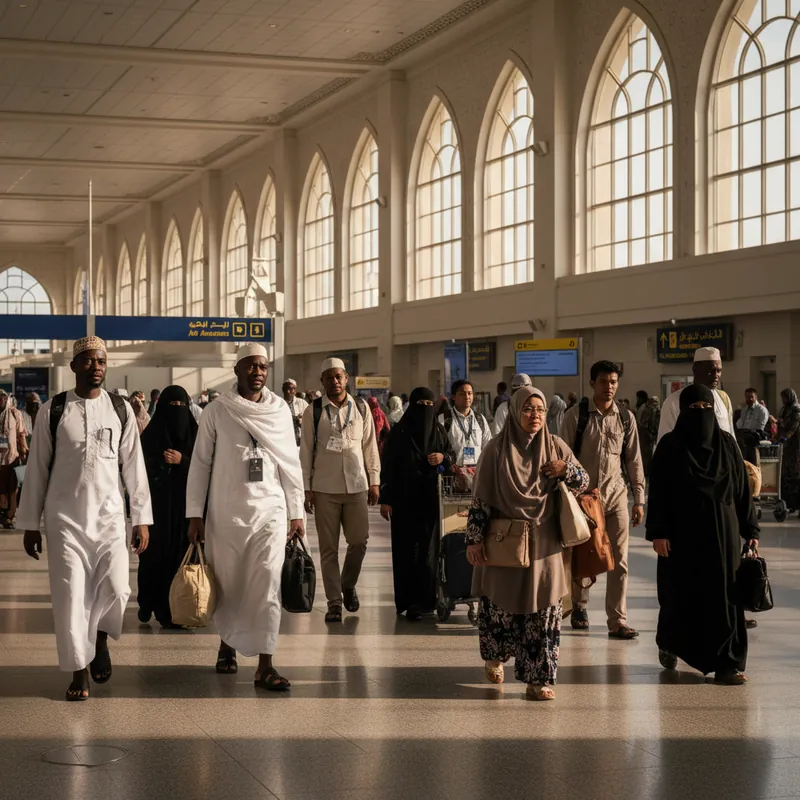
Umrah 2026 Year-Round: Saudia vs Emirates for African Muslims
For African Muslims, Hajj is the major pilgrimage performed once in a lifetime as the 5th pillar of Islam. Umrah is the lesser pilgrimage — a subset of Hajj rites — that can be performed at any time of year and is not bound by the national-quota system that governs Hajj. For the very large African Muslim population that may face a multi-year wait for a NAHCON, SAHUC, KAHCON or GHC Hajj quota allocation, Umrah offers a year-round path to Mecca that requires only the Saudi Ministry of Hajj Umrah eVisa and a direct flight booking. This guide unpacks the Umrah eVisa process, the Saudia vs Emirates flight comparison for African origin airports, the Ramadan vs Rajab vs shoulder-season timing trade-offs, and the realistic 2026 cost stack.
TL;DR: Umrah 2026 is year-round (NOT seasonal like Hajj) and does NOT require NAHCON, SAHUC, KAHCON or GHC intermediation. The Saudi Ministry of Hajj Umrah eVisa costs approximately $300 directly via the Nusuk portal. Flight from LOS/ABV/JNB/CPT/NBO/ACC/EBB to JED ranges $700-1,200 one-way on Saudia (SV) direct or Emirates (EK) DXB-connection. Total Umrah package (flight + Mecca-Madinah hotel + meals + ground) for an African pilgrim lands at $1,800-3,200 for a 7-10 day trip. Best 2026 Umrah windows: September-October (lowest cost, lightest crowds), Rajab (around January 2026, moderate cost), Ramadan (February-March 2026, most spiritually significant but +40-70 percent on price).
In this guide
- Umrah vs Hajj for the African Muslim pilgrim
- Saudi Umrah eVisa year-round process
- Saudia direct vs Emirates DXB-connection comparison
- Ramadan vs Rajab vs shoulder-season timing
- Three African pilgrim case studies
- Frequently asked questions
Umrah vs Hajj for the African Muslim pilgrim {#umrah-vs-hajj}
Umrah and Hajj are both pilgrimages to Mecca, but they differ materially in obligation, timing and quota structure.
| Dimension | Hajj | Umrah |
|---|---|---|
| Religious status | 5th pillar of Islam, obligatory once in a lifetime if able | Highly meritorious but not a pillar |
| Timing | Dhu al-Hijjah (late May / early June 2026) — exclusively | Any time of year |
| Visa | Saudi Hajj visa, quota-allocated via national council | Saudi Umrah eVisa, direct application |
| Intermediation | NAHCON / SAHUC / KAHCON / GHC + accredited operator | None required — direct via Nusuk portal |
| Quota | Yes (1:1,000 Muslim-population formula) | No quota |
| Rites | Tawaf + Sa’i + Mina + Arafat + Muzdalifah + Stoning + Halq + Tawaf al-Ifadah | Tawaf + Sa’i + Halq or Taqsir (subset of Hajj rites) |
| Duration | 5-6 days of formal rites within a 25-30 day total trip | 1-2 days of rites within a 7-14 day total trip |
| Typical 2026 cost (African pilgrim) | $2,500-5,500 | $1,800-3,200 |
For an African Muslim who has not yet performed Hajj, the typical practical sequence is to apply through the relevant national Hajj council (NAHCON, SAHUC, KAHCON, GHC) and to perform Umrah in the intervening years — often multiple Umrahs — until the quota allocation is secured. For an African Muslim who has already completed Hajj, Umrah is a recurring optional pilgrimage that many perform annually or biennially.
Umrah does NOT count as a substitute for Hajj. The Hajj obligation as the 5th pillar of Islam is distinct from the recurring Umrah practice.
Saudi Umrah eVisa year-round process {#evisa-process}
The Saudi Ministry of Hajj and Umrah operates the Nusuk platform — the single official portal for Umrah eVisa applications. The process is direct: no national Hajj council intermediation is required.
Application steps
- Open a Nusuk account at the Saudi Ministry of Hajj and Umrah portal. Identity verification is via passport number and email.
- Submit eVisa application — passport scan (at least six months remaining validity), recent passport-style photograph, intended travel dates.
- Provide proof of return flight booking — most operators allow a hold-booking on Saudia, Emirates or other carrier sufficient for the eVisa stage.
- Provide confirmed Mecca accommodation booking — required for eVisa approval. Booking.com and Saudi-specific hotel platforms support this.
- Pay fees — approximately $300 total: eVisa fee, processing fee, Saudi tourism levy. Payment by international card.
- Wait 48-72 hours for eVisa approval. The approved eVisa is delivered as a PDF document by email.
The Umrah eVisa permits a stay of up to 90 days and is valid for one Umrah trip within one year of issuance. It is a single-entry document for the specific trip.
What the Umrah eVisa does NOT cover
The Umrah eVisa is not valid for Hajj — performing Hajj rites requires the separate Saudi Hajj visa allocated through the national quota system. The Umrah eVisa is also not valid for general tourism outside the religious-purpose framework — Saudi has separate Tourism eVisa categories for general visitation.
Saudia direct vs Emirates DXB-connection comparison {#saudia-vs-emirates}
The two principal carriers for African-origin Umrah flights to Jeddah are Saudia (SV) and Emirates (EK). Their products differ materially in cabin, schedule and cost.
Saudia direct from African gateways
| Origin | Aircraft | Duration | One-way 2026 USD |
|---|---|---|---|
| LOS Lagos | Boeing 777-300ER | 7h 20m | $700-950 |
| ABV Abuja | Boeing 777-300ER | 7h 15m | $700-950 |
| JNB Johannesburg | Boeing 777-300ER | 9h 15m | $750-1,000 |
| CPT Cape Town | via JNB or supplementary direct | 11-14h | $850-1,150 |
| NBO Nairobi | Boeing 777-300ER | 5h 45m | $700-900 |
| ACC Accra | Boeing 777-300ER | 7h 30m | $800-1,100 |
| EBB Entebbe | via NBO or via supplementary direct | 7-9h | $700-950 |
Saudia is the Saudi national carrier and operates with the full Saudi religious-service infrastructure: dedicated Hajj/Umrah terminal handling at JED, alcohol-free fleet, Qibla direction displayed on every seat-back monitor, and rear-galley prayer space throughout the flight. Saudia direct routings are typically the most efficient and the highest-rated by African Umrah pilgrims for the religious-service consistency.
Emirates DXB-connection
| Origin | First leg | Connection | Second leg | Total duration | One-way 2026 USD |
|---|---|---|---|---|---|
| LOS Lagos | LOS-DXB on A380 or 777 | 2-4h DXB | DXB-JED on 777 | 11-13h | $650-900 |
| ABV Abuja | ABV-DXB on 777 | 2-4h DXB | DXB-JED on 777 | 11-13h | $650-900 |
| JNB Johannesburg | JNB-DXB on A380 | 2-4h DXB | DXB-JED on 777 | 11-13h | $650-900 |
| CPT Cape Town | CPT-DXB on A380 | 2-4h DXB | DXB-JED on 777 | 14-16h | $750-1,000 |
| NBO Nairobi | NBO-DXB on 777 | 2-4h DXB | DXB-JED on 777 | 9-11h | $600-850 |
| ACC Accra | ACC-DXB on 777 | 2-4h DXB | DXB-JED on 777 | 13-16h | $700-950 |
Emirates offers a different value proposition: typically slightly lower seat rate, plus the Emirates A380 cabin product on the long-haul first leg (where deployed) which is consistently rated highly. The trade-off is the DXB layover (typically 2-4 hours) and the longer total journey. Emirates’ DXB facility has dedicated Hajj/Umrah handling during peak seasons and is well-equipped for pilgrim cohorts.
Saudia vs Emirates: the practical choice
For most African Umrah pilgrims, the choice between Saudia direct and Emirates DXB-connection comes down to four factors:
- Time vs cost — Saudia direct saves 3-6 hours; Emirates often saves $50-150.
- Cabin product preference — Saudia’s religious-service consistency vs Emirates’ A380 cabin amenity.
- Schedule fit — Saudia’s direct rotations are once-daily on most routes; Emirates’ DXB hub offers multiple daily connection options.
- Group travel — large Umrah cohorts often default to Saudia direct for the operational simplicity.
Ramadan vs Rajab vs shoulder-season timing {#timing-comparison}
The timing of an Umrah trip materially affects both cost and crowding. The three principal Umrah season windows for the 2026 calendar are:
| Window | Period | Crowding | Cost premium vs shoulder | Spiritual emphasis |
|---|---|---|---|---|
| Ramadan | Approximately 17 Feb - 18 March 2026 | Highest | +40 to +70 percent | Highest — Umrah in Ramadan carries narrated reward equivalent to Hajj |
| Rajab | Approximately 17 Dec 2025 - 15 Jan 2026 | Moderate | +10 to +20 percent | Traditional Umrah season, cooler weather |
| Shoulder | September-October 2026, November 2026 | Lowest | Baseline | None specific |
Ramadan Umrah for African pilgrims
Ramadan Umrah is the most spiritually meritorious season. African Muslims who can afford the cost premium typically prefer the last 10 days of Ramadan when Laylat al-Qadr is sought. The cost trade-off is substantial: flight fares from African gateways rise 40-70 percent, and Mecca hotel rates in the Haram precinct rise 100-200 percent. Many African Ramadan Umrah pilgrims book 6-9 months in advance to lock in the lower-band fares.
Rajab Umrah
Rajab (the seventh Islamic month) is a traditional Umrah season with cooler Mecca weather and moderate crowds. For African pilgrims this typically falls in December-January 2026 — a window that fits well with year-end leave for many professionals. Costs are 10-20 percent above shoulder rates but well below Ramadan.
Shoulder-season Umrah
September, October and November 2026 are the lowest-cost Umrah windows of the year. Mecca weather is warm but tolerable, crowds are lightest, and total package costs land at the bottom of the range. Many African Umrah cohorts organised through tour operators default to these months for the cost efficiency.
Three African pilgrim case studies {#case-studies}
Case 1 — Mr Abubakar Lawal, Kano (Nigeria), 44, retail electronics wholesaler
Mr Abubakar performed Hajj in 2019 through the Kano State Pilgrim Welfare Board. He has performed Umrah twice since — once in 2023, once in 2024 — and is planning his 2026 Umrah for the last 10 days of Ramadan (approximately 8-18 March 2026). His package is a self-organised trip: KAN-LOS feeder on Air Peace, then LOS-JED direct on Saudia 777-300ER, returning to LOS-KAN. Mecca hotel: 600 metres from the Masjid al-Haram for 10 nights, Madinah: 4 nights at a standard hotel. Total trip cost: approximately $2,900 (NGN 4.5 million). Saudi Umrah eVisa: applied directly via the Nusuk portal, $300, approved within 48 hours.
Case 2 — Mrs Aisha Mohamed Salie, Cape Town (South Africa), 38, accountant
Mrs Aisha has not yet performed Hajj — she is on the SAHUC Cape Malay community quota wait-list and expects allocation in 2027 or 2028. She is performing her first Umrah in September 2026 (shoulder season) as part of a Bo-Kaap community women’s cohort of 14 organised through a SAHUC-accredited operator who runs both Hajj and year-round Umrah. Her package: CPT-DXB-JED on Emirates A380 + 777, 7 nights in Mecca (800 metres from the Haram), 3 nights in Madinah. Total trip cost: approximately R 38,000 ($2,080). Saudi Umrah eVisa: arranged by the operator, included in the package cost. As a woman aged 38 travelling within an organised group, no individual Mahram requirement.
Case 3 — Sheikh Suleiman Bello, Nairobi (Kenya), 67, retired Islamic scholar
Sheikh Suleiman performed Hajj in 2008 through KAHCON. He performs Umrah annually as a personal religious practice and is planning his 2026 Umrah for Rajab month (mid-December 2025 through mid-January 2026). His package: NBO-JED direct on Kenya Airways 787-8 Dreamliner, 8 nights in Mecca at a Premium hotel (300 metres from the Masjid al-Haram), 4 nights in Madinah. Total trip cost: approximately KES 290,000 ($2,250). Saudi Umrah eVisa: applied directly via the Nusuk portal, $300, approved within 72 hours. Sheikh Suleiman travels with one adult son.
Frequently asked questions {#faq}
1. Do African Umrah pilgrims need to go through NAHCON, SAHUC, KAHCON or GHC? No. Umrah is the lesser pilgrimage and operates outside the Hajj quota system. African Muslim pilgrims apply directly for the Saudi Umrah eVisa through the Saudi Ministry of Hajj and Umrah Nusuk portal, paying approximately USD 300 in eVisa and processing fees. NAHCON, SAHUC, KAHCON and GHC administer the Hajj quota specifically; Umrah does not require their intermediation. Many African Muslims perform Umrah independently or in informal family groups year-round.
2. What is the difference between Umrah and Hajj for the African Muslim pilgrim? Hajj is the major pilgrimage performed once in a Muslim’s lifetime as the 5th pillar of Islam, occurring exclusively in the Islamic month of Dhu al-Hijjah and requiring a quota-allocated Saudi Hajj visa. Umrah is the lesser pilgrimage performed at any time of year, requiring a separate Umrah visa issued directly by the Saudi Ministry of Hajj and Umrah. Umrah rites are a subset of Hajj rites (Tawaf, Sa’i, halq or taqsir) and typically completed in a single visit to Mecca. Umrah is not a substitute for Hajj but is widely performed by African Muslims, often after the Hajj quota wait or as a year-round spiritual practice.
3. When is the best time of year for African Muslims to perform Umrah in 2026? Ramadan (February-March 2026) is considered the most spiritually meritorious Umrah season but is also the most crowded and the most expensive — flight and accommodation prices in Mecca during Ramadan typically rise 40-70 percent above shoulder rates. Rajab month (around January 2026) is a traditional Umrah season with cooler weather and moderate crowds. September-October 2026 is a shoulder season with the lowest prices and lightest crowds. Many African pilgrims choose September-October or November for a more relaxed Umrah experience with lower total cost.
4. How does the Saudi Umrah eVisa application work in 2026? Applications go through the Saudi Ministry of Hajj and Umrah Nusuk portal at usual fees of approximately USD 300 inclusive of eVisa, processing and Saudi tourism levy. The applicant submits a valid passport (at least six months remaining), a recent photograph, return flight booking and confirmed Mecca accommodation. Processing is typically completed within 48-72 hours. The Umrah eVisa permits a stay of up to 90 days and is valid for travel within one year of issuance. The Umrah eVisa does not require local Hajj council intermediation.
5. Do African Muslim women require a Mahram for Umrah in 2026? Saudi Ministry of Hajj policy since 2021 permits women aged 18 and above to perform Umrah without an individual Mahram. The policy applies equally to Umrah and Hajj, and African Muslim women travelling independently or in informal family groups can apply for the Saudi Umrah eVisa directly. Many African Muslim women travel for Umrah as part of family cohorts or organised tour-operator groups, but solo independent travel is permitted under current Saudi policy.
Planning your 2026 Umrah journey
Umrah is the year-round counterpart to the once-in-a-lifetime Hajj — a recurring spiritual practice for the African Muslim community that does not depend on the national quota system. The Saudi Ministry of Hajj Umrah eVisa is direct and procedural, the flight options from every major African gateway are well-developed, and the timing flexibility means a pilgrim can choose between the spiritual depth of Ramadan, the moderate traditions of Rajab, or the cost efficiency of the shoulder seasons.
For the Hajj-quota counterpart pillars covering each major African country, see our parallel guides: NAHCON Nigerian Hajj 2026, the SAHUC South African Hajj Cape Malay community, the KAHCON Kenya Hajj 2026 Mombasa pilgrim, the GHC Ghana Hajj 2026 Accra pilgrim, and the LOS-JED Air Peace vs Saudia Nigerian Hajj comparison. The cross-country Hajj quota tracker gives the comparative allocations across the four major African Hajj bodies.
For live fare tracking on the major African-origin Umrah routings, see our Johannesburg to Jeddah flights page, Lagos to Jeddah flights page, Nairobi to Jeddah flights page, the dedicated Saudia airline guide and Emirates airline guide.
Sources
- Saudi Ministry of Hajj & Umrah — Umrah Visa Guide
- GACA — Saudi Aviation Authority Regulations
- Nusuk — Official Umrah Booking Portal
- IATA — Hajj & Umrah Operations Bulletin
- Saudi Tourism Authority — Visa-on-Arrival Rules
Last verified: 2026-06-22